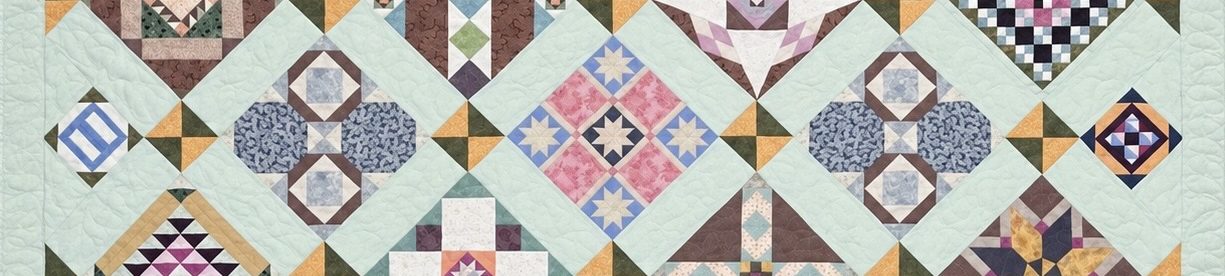
I was lucky enough to see the full eclipse of the sun in April 2024 in my Niece’s backyard in Panton Vermont. The Eclipse Star block is based on an arrangement my 8 year old Grandniece Iris came up with when we were playing with her wooden blocks that are shaped like quilt pieces. And, to explain the name of the quilt I will tell you that while in the middle of being stunned by what we were seeing, suddenly, we were wondering which planet is that below the eclipsed sun? Just as suddenly the moon continued on its path and the sky was full of light again.
I was able to replicate Iris’s block design in Electric Quilt and then I also found the paper pieces and acrylic templates for sale at Paper Pieces so that I could put the block together using the English Paper Piecing method.
Here is an overview of the process I went through for piecing the block together.
If you are interested I have a put together a FREE pattern for the star block, but please be familiar with the EPP method.
The Back of the Quilt is interesting, too, with the quilting for the sun highlighted.
This quilt was exhibited at Boston City Hall in March 2025 along with my Medallion Quilt. The best part is that it was featured on the advertising graphic.
This quilt was inspired by the ceramic coaster that my cup of tea rested on while I was sewing. It is based on the Mariner’s Compass pattern, one of the oldest quilt patterns that echoes a wind rose diagram used for navigating the seas In the 13th century. I hope this quilt is a helpful inspiration for finding your way through life.
I designed the quilt using Electric Quilt. I had a few different design ideas in mind and made a test border block. I used Foundation Paper Piecing to sew all the pieces together which helped with accuracy. The center was a bit of a challenge because so many points are meeting in the center. The appliqued center piece solved the problem.
I am quite satisfied with how the quilting came out on this one. I tend to rely on my pantographs, but I knew this one needed some custom quilting.
This quilt was displayed in Boston City Hall along with an exhibit by the Boston Modern Quilt Guild March 2024. My Eclipse Quilt was also on display. I also exhibited these quilts at the BMQG Show in September of 2024.
I can’t believe the last time I shared anything on my website was in 2021. I have created quite a few quilts in the last five years and it is high time I shared some photos and some thoughts about them.
Let’s start with some mini quilts: These are between 16″ and 20″ wide.
The TV quilt was made for the Boston Modern Quilt Guild Dewey Decimal Challenge. This has been going from library to library for about 4 years now. I miss that little quilt!. This house quilt is my Niece Chrissy’s house in Panton VT.
I made these two denim quilts as part of a Boston Modern Quilt Guild challenge to reuse denim fabric. The Xs and Os Quilt was exhibited at the Museum of Science and the Star was exhibited at the Boston Public Library.
These are full sized quilts. I still have 11 of these quilts. The others have been gifted for various reasons.
Here are some Progression Panel Quilts using Convergence Blocks in the corners. This was a very popular class at Quilters Common. I do miss Quilters Common. I have a pattern for a Progression Panel Quilt available on my FREE Patterns page.
Here are some quilts made as group projects for various charities.
Here are quilts that are collaborative efforts. The Seven Sisters Quilt is made with a collection of blocks I got on eBay. Each block was made and signed by a different woman. I had fun putting it together. The second was a BMQG Bee. We had groups of six people and this is the design, my Improv Recipe, I chose for the group I was in when it was my turn. So fun, and these are quilts we were told to keep and enjoy.
I was asked to make more Tie Quilts. These ties belonged to Jane’s brother who died too soon, and she asked if I would make quilts for his 3 kids, and there were enough to make one for her, too. Coincidentally, these were also Tom’s ties, for those who remember the last Tie Quilt that I made.
For Vaughn 50” x 50”For Aaron 50” x 50”For Breanne 50” x 50”For Jane 50” x 50”
This gives you a pretty good idea of what I have been doing! I am going to do some more posts focusing on some quilts that have interesting stories that must be shared properly!
The Boston Modern Quilt Guild has quite a few quilts on display at the Morse Institute Library in Natick, MA until the end of December.
We had to put the show together quickly so I grabbed some of my latest creations for consideration. Four of my quilts are on display. 3 of the 4 are Minnies and 3 of them are improv quilts. Definitely having fun playing with improv these days.
Here is another project that I recently finished. This quilt uses 3 panels. Two of the panels are cut into strips with background fabric using the Ricky Tims Convergence block technique.
I will eventually be teaching the process in a workshop at Quilters Common in Wakefield, but for now the pattern is available at the shop.
UPDATE: You can now download a digital version of the pattern on the FREE PATTERNS Page .
I quilted this with a pantograph. The one I used is called flames, but I loaded the quilt on my longarm frame so that the panto actually looks like clouds/waves to complement the panel.
I have been playing with improv blocks and arranging them together to make placemats. This is going to be a workshop at Quilters Common in Wakefield, MA as soon as we can be comfortable and safe in the cozy classroom area there. It is a fun way to introduce folks to improv if they haven’t tried it yet. You can download the pattern on my FREE PATTERNS Page
I meant to do a post to celebrate winning a best long arm quilting award from the Spring Mancuso show. The show was virtual so this involved sending them photos for judging. This is the Quilt I made for Tom which is discussed further in this previous post.
I am taking a virtual quilting workshop that is basically a lot of fun, BUT, the instructor is relying on the traditional Red, Yellow and Blue color wheel for choosing the colors to use in our quilts.
For example, I randomly chose Tetrad Blue. So, I made an improv quilt with two sets of complimentary colors: Blue/Orange and Red-Violet/Yellow-Green. The idea was to start with monochromatic blocks with different values of the colors and then mix them all together. The mixing proved too chaotic and I felt it was a non-harmonic clashing mess. So rather than merge it all together, I softened the look with negative space and came up with this:
And I ended up liking it. Sometimes I even love it. It definitely looks better in person.
Next up was a small minimalistic quilt. I tried working with the color wheel but ultimately the blue fabric I picked seemed to look really interesting with the yellow and yellow green fabrics I pulled out of my stash. But, even though I thought it all looked okay together, I could not make it work on the color wheel. I pulled out my Ultimate 3-in-1 Color Tool by Joen Wolfrom and still could not justify the use of my colors. Regardless, I decided to use the colors:
Maybe improv is not your thing, but I do think the colors work, and it was a fun time putting it together. And, yes, it went beyond minimalistic, but never mind about that!
So I began wondering about the use of the color wheel for quilting. Should I be relying on it to pick “complimentary” colors? Do orange and blue go together? Here is an article I came across: https://blog.asmartbear.com/color-wheels.html
If you read through the article you will see alternative color wheels. Both the wheel based on light and the one based on the CMYK printing ink (process color) show yellow across from or complimenting blue, rather than orange. And, that is what I did in my second quilt.
If I had followed the traditional mixing color wheel I would have had a violet and yellow quilt.
There is a lot of discussion regarding the traditional color wheel and its shortcomings. Here is another article: https://www.handprint.com/HP/WCL/color13.html. I have not read through the entire discussion, but the point it this: the Wheel is controversial! My favorite quote from that article is this: “Experienced artists learn to use the color wheel as a compass to color improvisation“
I also have another tool that my friend Peggy Anne recommended years ago, The Color Scheme Bible by Anna Starmer. She used this to put quilt kits together for her shop for years with great success. I did not find any schemes that featured Orange and Blue in Anna’s book.
My friend Susan is a quilting pattern genius. She looks at things with an open mind and suddenly has an amazing new way to construct a block that avoids fussy bias warping triangle hassles.
Here is a her latest diagonal thinking genius breakthrough in pictures.
looking wonky and unconventional!
sew them togethercut on the OFFSET diagonaltwo wonky unitsnext steptrim looking goodI LOVE it!
This method is wonderfully precise and does not wast that much fabric. My big question: HAS ANYONE EVER SEEN THIS METHOD BEFORE???